Labels

90th Kokufu-ten Exhibition (1) ABC (4) ABC4 (1) Akira Bonsai (2) ambrevatte (1) Apple (1) AusBonsai (1) Bilimbi (1) Bilimbi Rond (1) Bjorn Bjorholm (1) Bjorvala Bonsai Studio (1) Bonsai (67) bonsai artists (5) Bonsai Club Mauritius (5) bonsai competition (1) bonsai competition 2013 (3) Bonsai Europa (1) Bonsai Events (2) bonsai experiment (1) Bonsai From Seed (8) Bonsai Lovers (2) Bonsai Mauritius (60) Bonsai Mauritius for Sale (6) Bonsai nursery Mauritius (4) Bonsai progression (18) Bonsai Videos (1) Breynia (1) Carving (1) casuarina 001 (1) cherry (2) Clerodendrum (2) Clerodendrum Bonsai (2) Clerodendrum Smithianum Bonsai (2) Clerodendrum Smithianum Bonsai 001 (2) Cryptomeria 001 (1) Cryptomeria japonica (1) cuphea (5) cuphea 001 (2) cuttings (1) deadwood (1) DIY (1) Eagle Entrepreneur Award (1) false bonsai mauritius (1) fern (1) ficus (7) Ficus 002 (1) Ficus 003 (2) Ficus benjamina (2) Ficus bonsai (5) ficus retusa (1) ficus retusa bonsai (1) ficus rubiginosa (2) ficus rubiginosa #2 (2) François Jeker (1) Hem Collection (3) Jan Culek (2) John Naka (1) juniper (3) Kaori Yamada (1) kusamono (3) lantana (1) Laurent Breysse (1) Leucaena Leucocephala (3) Light Bulb Clerodendrum (2) Ligustrum (8) lime sulphur (2) Malpighia coccigera (4) Mauritius (15) moss (1) Nebari (4) Noelanders Trophy (1) ofBonsai (1) pine (1) Pinus Elliottii (1) Privet (4) Privet 001 (1) Privet 002 (1) Privet 003 (1) privet 011 (1) Repotting (8) rose (1) Ryan Neil (1) Ryuga (1) saika bonsai (1) Sakura (1) seed (6) Sergio Martínez (1) Shohin (1) Slash Pine (3) Slash Pine 001 (1) Slash Pine bonsai (2) Slash Pine Hem 002 (1) Smithianum (2) Species Guide (1) Styling (1) Tomio Yamada (1) Tony Tickle (2) Trochetia (1) Trochetia Boutoniana (1) Vaneron Garden Center (2) Walter Pall (3) white pine (1) Wiring (5) World Shohin Photo Awards (1) Yajay Goindo (1) Yamadori (2)
Showing posts with label Ficus bonsai. Show all posts

2013-11-20

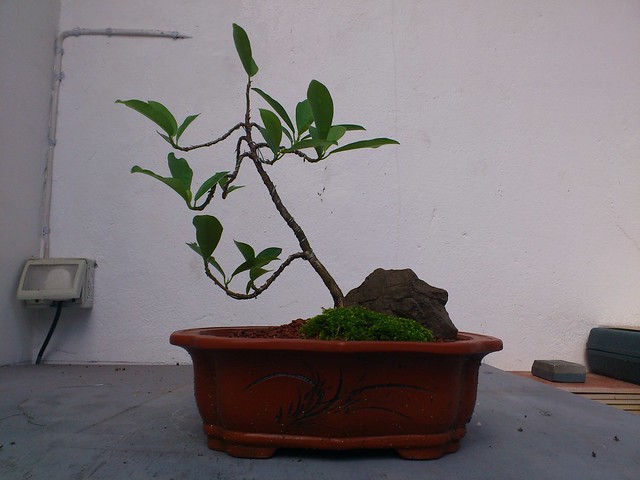
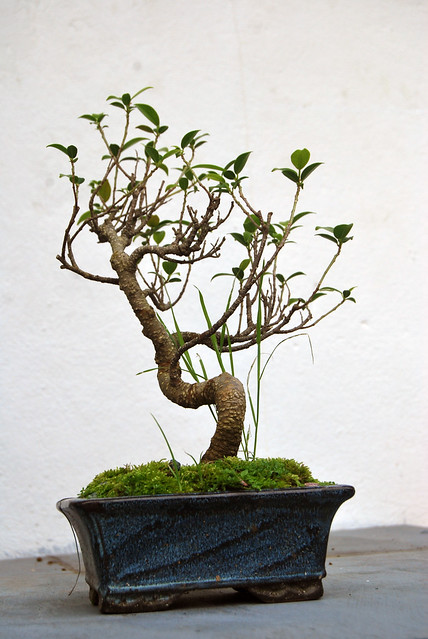
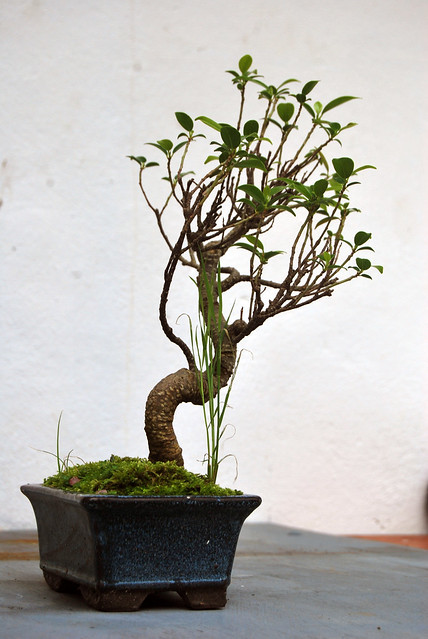
Ficus Benjamina : Shohin Weeping Bunjin

[ Ficus Benjamina : Shohin Weeping Bunjin - Part I  ]

Follow up on this ficus benjamina,
The tree was starting to grow into the wires on the thinner branches and I decided it was not safe to keep it any further.
My main concern was on several adventitious buds that were starting to appear only to dry off after some days.
Since the wires on the trunk was mainly for anchoring purposes, I also removed them in the same process.


DSCF4128
DSCF4129

After roughtly one month, the tree started to revert back. The branches were slowly moving up. I decided it was time to rewire the plant and also re-pot in a bigger training pot.
Its best to rewire and do any major work on your plant BEFORE re-potting it.
The main reason being that before the re-potting the plant is more stable.
After a re-potting session, the soil is usually loose and the plant more prone to moving while you wire and bend the branches.
A moving tree = moving root ball = feeder roots breaking = NO GOOD.


DSCF5460
Before wiring

DSCF5473
After wiring

Some closeup of the wiring [ before / after ]:
DSCF5463
DSCF5467

DSCF5468
DSCF5469
DSCF5470


After the wiring I went ahead and re-potted the tree.
Same old routine:
> Keep the feeder roots close to the base of the trunk/nebari
> Remove all thick lateral roots, this should also encourage the formation of new feeder roots.


DSCF5476
DSCF5477
DSCF5478
DSCF5481
DSCF5480
DSCF5482


2013-07-18

Ficus Benjamina : Shohin Weeping Bunjin

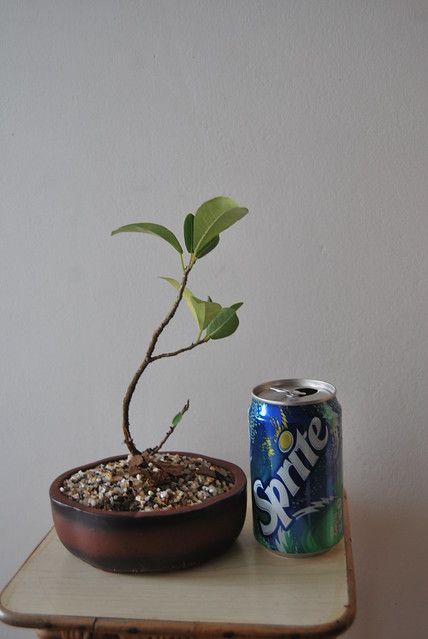
Progression of a Ficus Benjamina cutting that I started back in 2011.
Still a long way to go, this is a 1 year progression from 2012 till 2013.
I'm going for a shohin size [ < 250 mm ]
Initially it was going to be a classical bunjin, but during one of the wiring stages the image of a weeping style bunjin came in mind and that's the direction this design is going now.

Bunjin or literati is a special style in bonsai.
There are some rules and lots of free interpretation.


DSCF9244
DSCF9248
DSCF9250
DSCF9256
DSCF1001
DSCF3067
DSCF3072

I did mess up when I defoliated the tree, but I needed to see the structure I was creating without the leaves blocking the view.
It seems to have taken the stress rather well and is currently putting up new growth.


DSCF3091
DSCF3095
DSCF3429
DSCF3745
DSCF3742
DSCF3741


I think I will stick to this height for now and start to concentrate on the roots and ramifications.

2012-07-31

Ficus 003 - Preventing reverse taper

Ficus 003 - Preventing reverse taper

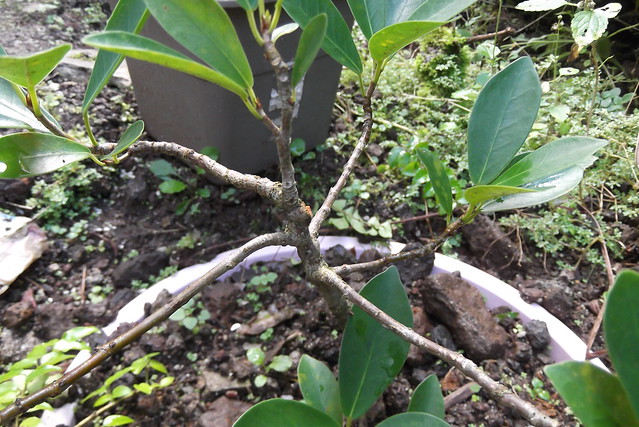
Identifying problematic structure. Those two branches are
opposite one another. If I leave it like this, the thickening below
the two branches will create a bulge, creating a reverse taper.
Reverse taper is difficult to correct once it has started. To
prevent it, I need to remove one of the two branches.
By following the alternating clockwise motion of the lower
branches up to the apex, its obvious that the right branch
should be remove and the left branch kept.
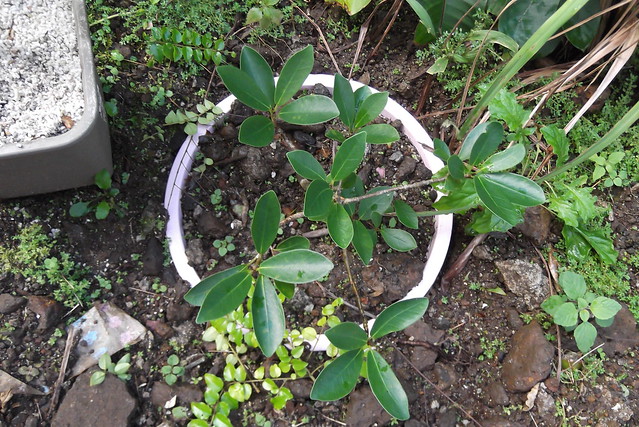
A top view of the branches disposition.
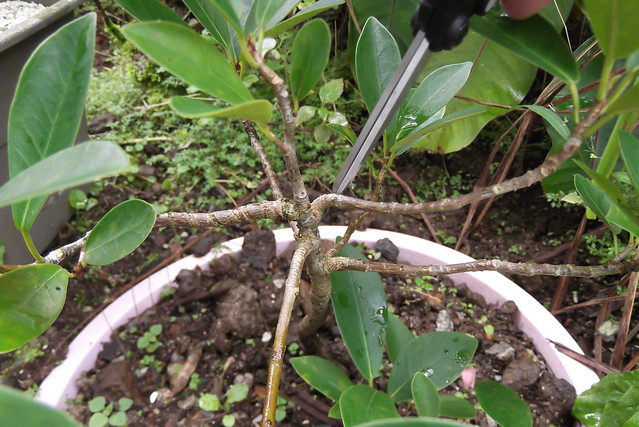
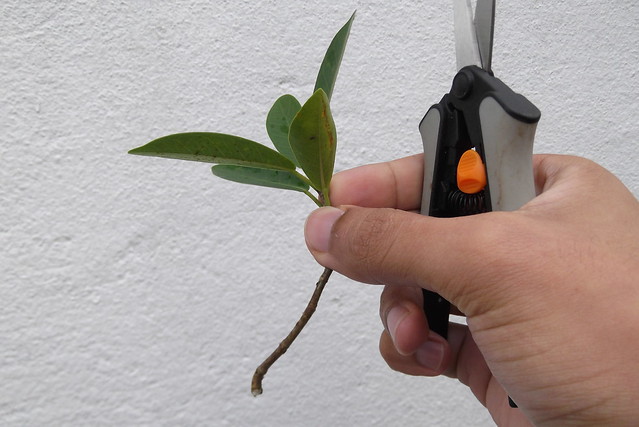
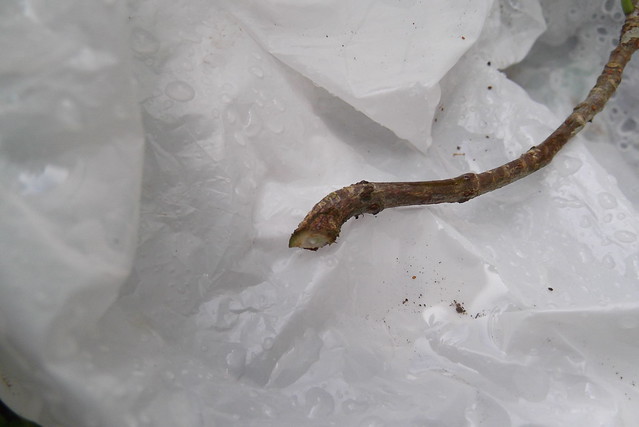
The removed branch. Since its a ficus, I could attempt a
cutting propagation out of it :)
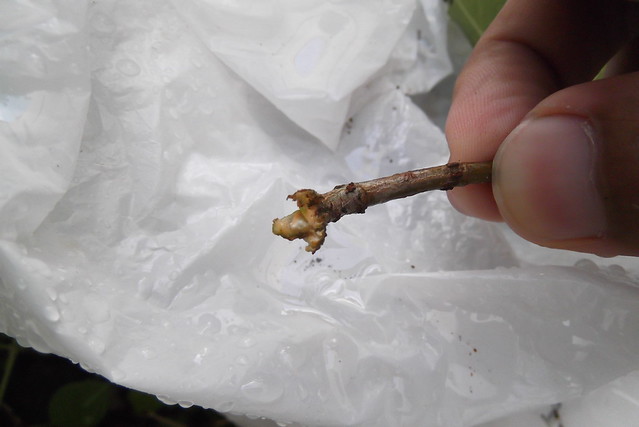
The tip of the branch - New root should grow out of it.
To further increase the chances for it to root, I cut it end in a
cross pattern and gently spread it open.
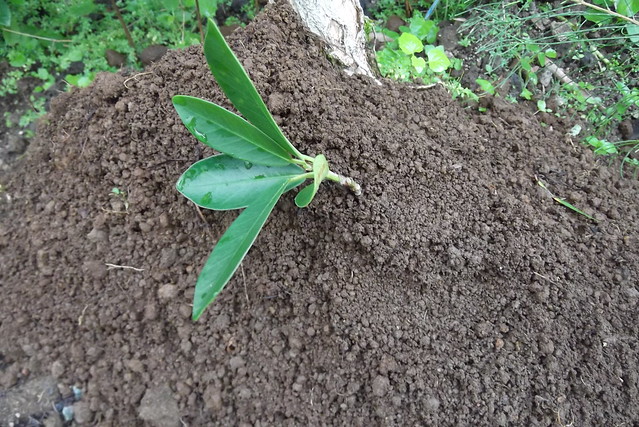
Placed in the ground - I'll check it back in 6 months.

Ficus 003 - Training experiment

Ficus 003 - Drastic change in the approach

This Port Jackson Fig [ Ficus Rubiginosa ] was growing on a wall for several years without much improvement in its growth.

I collected it in 2010 when I was just starting on bonsai and made the mistake of not working on the roots and taper. Instead I stuck that "stick" into a pot and left it there to thicken... I've just wasted 2 whole years on it... well not wasted, more like loss two years worth growth.
Plants dont thicken up that quick in a bonsai pot.

Last month I started a little experiment in growing trees in the ground
I have already 4 trees training in the ground and 2 other trees previously in the ground recently dug up.

One issue with training in the ground is that the lateral roots grow very long.
I end up pruning them in the end, because in a bonsai, you want a compact root made of the fine feeder roots.
You can keep some lateral roots as they will become your nebari, but you don't need a 30cm long lateral root.
You should also get rid of any tap roots at this stage in the training process too.

Here's the gist of my experiment.
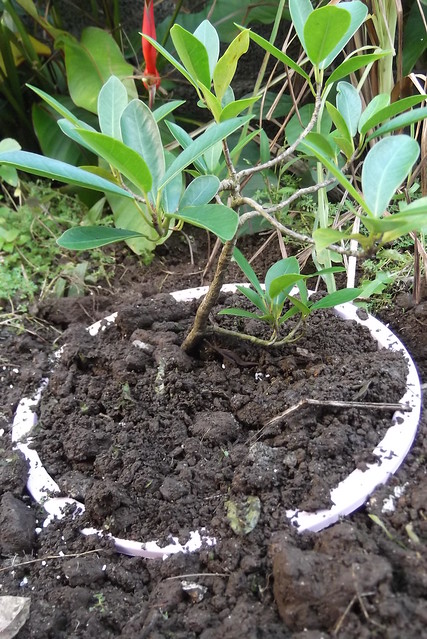
I'm using a basket in the ground [ cheap 0.5€ ones ]
The roots will be able to grow freely and pass through the holes in the basket.
Every six months or so, I'll dig up around the basket and cut off any lateral growing out of it.
In 1 year I'll have a look at the root structure and adjust any roots if need be.
In 2 years I'll see how much it has progressed compared to the first two you in the smaller bonsai pot.


The tree back in 2010 - Your classical beginner's
stick in a pot
In 2012 - In the pot, the growth goes in the branches but there
is little growth in the thickness of the trunk.
Trying out my experiment - Dig a hole, added several big flat stones
at the bottom of the hole. The added the basket. 
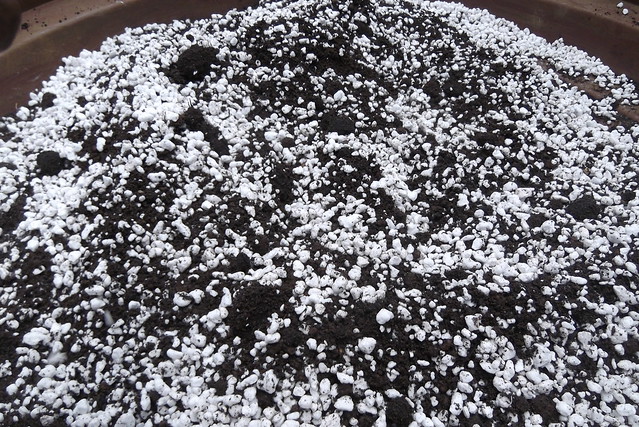
Prepared my soil mix - 3 part perlite, 3 part gardening soil and
1 part manure.
Mix them all together
The tree's root system. Its a mess and I did try at first to sort
it out, but gave up in the end. Several roots actually fused with
one another, typical ficus growth. Separating them would have
damaged the roots.
The basket's bottom was filled with the
soil mix, roughtly 1/3. Then the tree placed
at the center of the basket and then covered
with the rest of the soil mix.
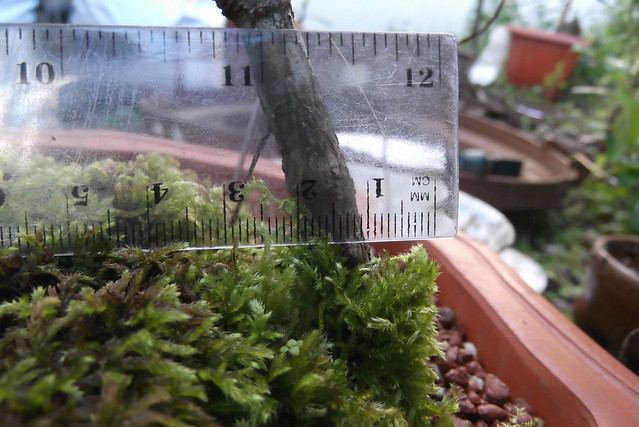
A shot before placing into the ground. Since 2010 to 2012,
this tree has thicken by 0.5cm approx. I wanted to have a
measure to see how much it will grow in the next two years.

2012-07-24

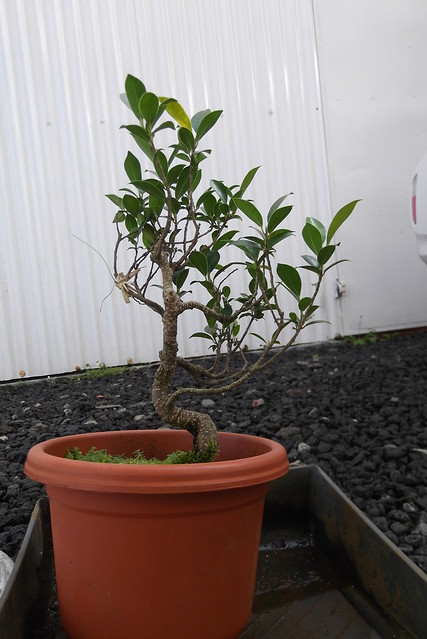
Ficus 002 - F. Retusa : Improving nebari


Bonsai : Ficus retusa

The bonsai has a nice flow of the trunk, but not much work has been done on the roots.

In 2011

In 2011

As it is above, it was basically a stick coming out of the pot.
There was no root system to expose, so the tree was placed into a slightly bigger "training" pot.
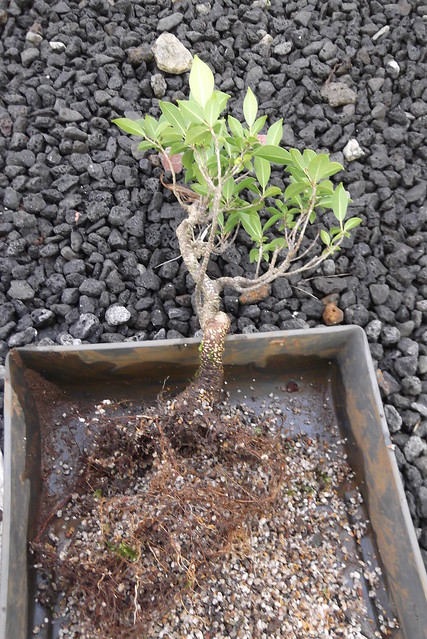
Earlier this week, I decided to have a look at the root development.

In its training pot

Unpotted - The roots are still tangled

Untangled roots - Lots of long roots

Untangled roots - Lots of long roots

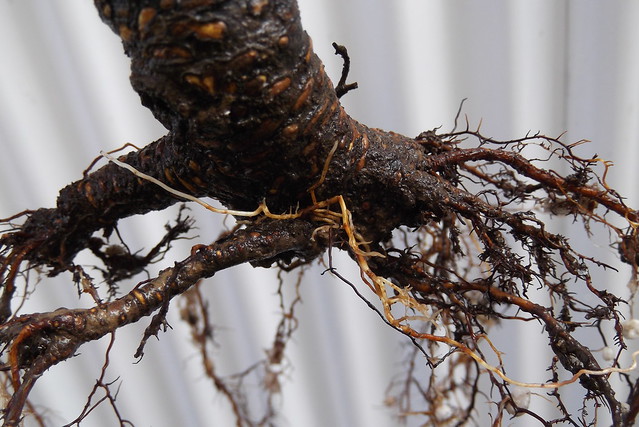
Feeder roots - The white/yellowish roots are the feeder roots.
Those are the roots that actually absorb nutrients and water
for the tree.

Since there  are several feeder roots growing out of the base
of the trunk, I've taken the risk of greatly reducing the root
mass. There are still lots of feeder roots at the tips of the roots.

A close-up of the feeder roots near the base of the trunk.

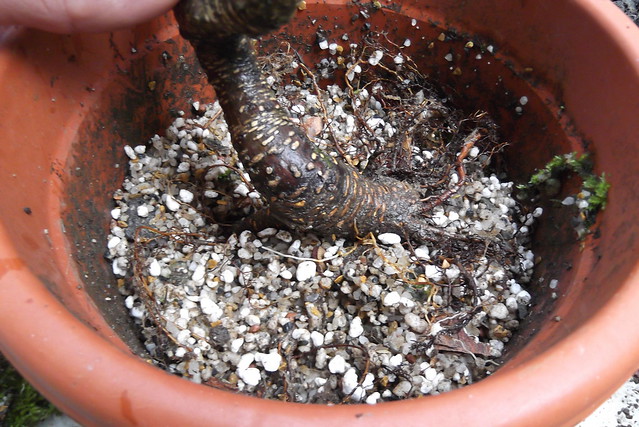
Placing the tree back into the training pot - Spread the
roots as much as possible.

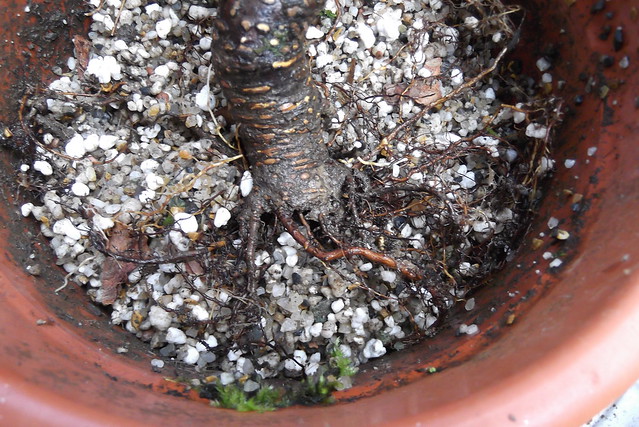
Placing the tree back into the training pot - Spread the
roots as much as possible.

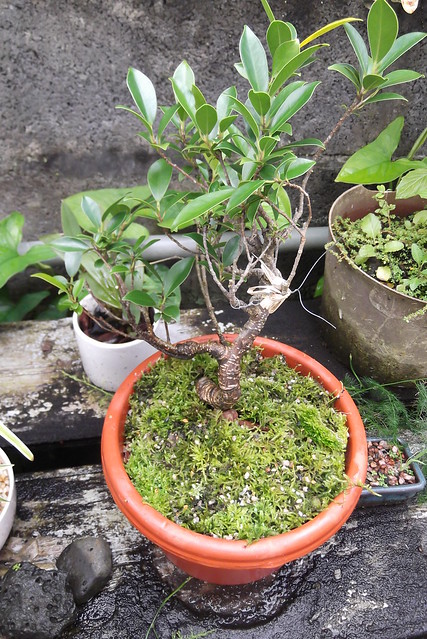
After repotting - Will let the tree rest for 3~4 weeks,
then start you can start fertilizing